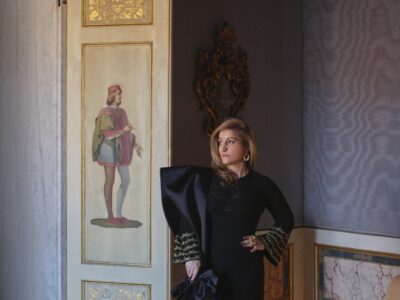
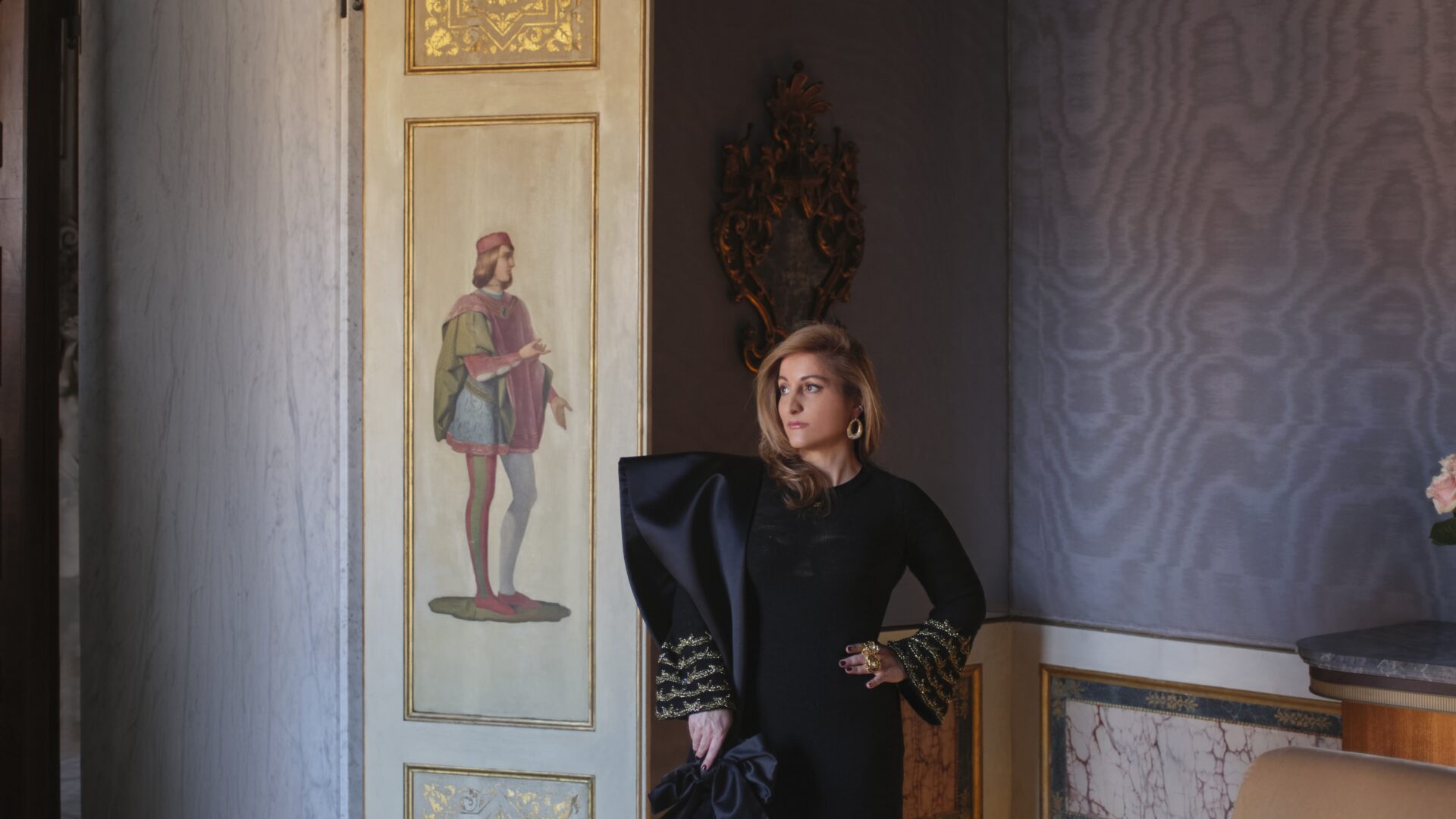
In Venice, architect and interior designer Aline Asmar d’Amman spent eight years transforming a fifteenth-century palazzo into the Orient Express Venezia. She speaks to Artkolik about the craft of restoring historic buildings, the Venetian muse who inspired the hotel’s restaurant, and the Istanbul library she would love to reimagine.
In March 2026, the fifteenth-century Palazzo Donà Giovannelli opened its doors as the Orient Express Venezia. Architect and interior designer Aline Asmar d’Amman spent eight years working on the project, restoring the former Venetian residence and adapting it for its new life as a hotel.
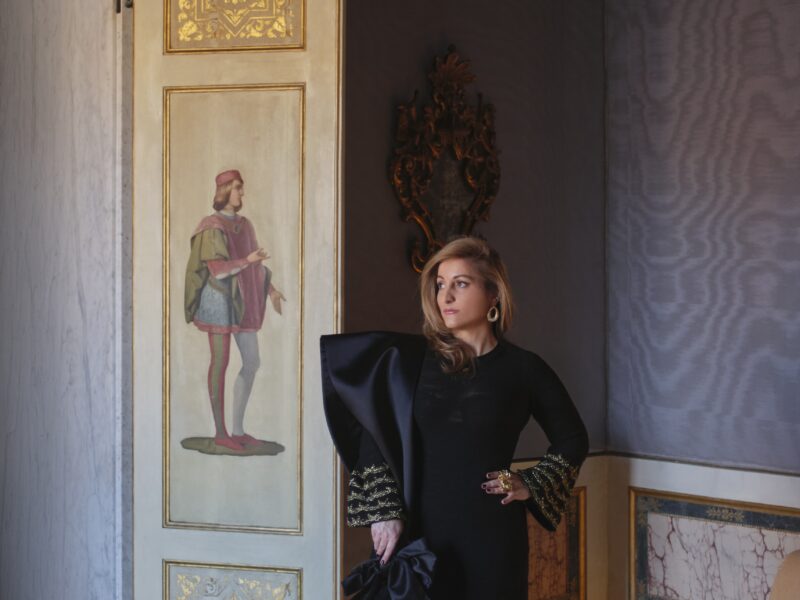
Born in Beirut, d’Amman is an architect and interior designer and the founder of Culture in Architecture, a studio based in Paris and Beirut. She directed the interiors of the Hôtel de Crillon renovation in Paris, collaborating with Karl Lagerfeld on its Grands Appartements, and designed the interiors of Le Jules Verne, the restaurant at the Eiffel Tower. Her work also extends to exhibition design, including the scenography of the Lebanese Pavilion at the 2022 Venice Biennale.
In conversation with Artkolik, d’Amman reflects on why Venice felt familiar to her from the start, how the theatrical style of Marchesa Luisa Casati found its way into the hotel, and what she would preserve if she were given the chance to reimagine Istanbul’s Köprülü Library.
Orient Express is a brand with a strong history. How did you translate that heritage into a contemporary hotel?
Beyond a monument to history, I see the Orient Express Venezia at Palazzo Donà Giovannelli as a living story, where the past continuously shapes the future. It was important for me to honour the Palazzos history while reimagining it for the present, creating a dialogue between legacy and renovation, architectural truth and contemporary sophistication. I wanted to reveal what was already there and give it new life in a way feels both timeless and intimate. With poetic precision, I carried the Palazzo’s ageless romanticism into the present, reawakening its spirit for a new era of discerning voyagers. Before stories of material textures and interior decisions, this is a great architectural endeavor, transforming what was once a private mansion into a hotel. Crafting a living space on the ground floor in what was and open courtyard with wooden ancestral beam, enclosing its façades and creating a lobby. Collaborating with specialist engineers who sometimes become super divers and analyse the walls under the laguna, then learning from them that a damn and drying each stone is necessary. Finding ways to integrate function with grace, add plumbing without denaturising a space, padding walls to create a layer of technical piping hidden behind silky moirés. all around the 15th century Palazzo to consolidate. From tinted mirrors, embossed leathers and sculpted boiserie’s that are placed in quiet dialogue with patinated frescoes and plush velvets, architecture and romance combine their narrative while underlining the cinematic character of the décor.
A subtle balance between heritage and modern comfort that creates a distinct atmospheric vibrancy, elevated by Orient Express’s signature luxury. Each corner invites for a deeper discovery into the Palazzo’s many stories where every detail is carefully considered. References to the golden age of travel are woven throughout. Travel trunks appear as bedside tables, a nod to the rituals of departure and arrival. Bespoke mini bars invite interaction, opening like curated cases designed to spark curiosity and engagement, reinforcing the journey of discovery. Whether within the intimacy of a room or the scale of a historic salon, there is always this tension. Between stillness and movement, between intimate and grand, between past and present. My approach is never nostalgic of the past but in conversation with it.

Venice has long been a meeting point between East and West. How did you connect the cultural legacy of the Orient Express with the unique identity and history of the city?
Venice has long drawn artists not only for its beauty, but for its layered identity. Positioned along historic trade routes, it became a crossroads of cultures, materials, and ideas, a city shaped as much by movement as by permanence. I am deeply inspired by Venice as a gateway between East and West. To me, it is almost an orientalist dream, a place where cultures and histories continuously meet and reflect one another, enriching each other.
Born in Beirut, I feel a very personal connection to the dual culture that Venice carries, I recognize many correspondences between Venetian architecture and my own cultural heritage. My attachment to Venice is therefore visceral and profoundly emotional. I never experienced the Serenissima as a foreign place, but rather with a sense of recognition, as if returning to a source of inspiration and origins. This dialogue between East and West is not only historical or aesthetic, but something that profoundly informs my architectural philosophy, a continuous exchange, a tension, and a harmony that shape the way I approach architecture and interiors.
This dual identity is already embedded in the Palazzo itself. The neo-Gothic staircase by Gian Battista Meduna leads to the Piano Nobile and reveals a layered architectural language, where Gothic forms meet intricate decorative work in stone, marmorino, and frescoes. I read the presence of both worlds – East and West – at the image of Venice, gateway to rich cultures: baroque Italian renaissance, arabesque influences and oriental patterns, neogothic galore, all reflected withing the luminous stained glass, capturing its long history of exchange and movement. In the Sala della Cultura historical salon, shaped by ideas and encounters, Venice expresses itself as it always has, a cosmopolitan meeting point where scholarship and spectacle coexist within the same space. Lapis lazuli tones, Italian marbles, and layered ornamentation create an atmosphere of richness and dialogue, while the meticulously vintage furniture and contemporary bespoke design coexist like a visual memory of a ‘grand tour’ with an orientalist sensibility, inviting indulgence and wonder. I imagined a continuation of this conversation, adding large plush velvet conversation sofas that take center stage, in dialog with the marmorino blue walls. The seating becomes the canvas for layered orientalist patterns laid with an ever-venetian vibe, inviting to indulge and wonder. A bespoke cabinet ensemble, filled with drinks throughout the day, becomes a natural gathering point flanked by orientalist Fortuny lanterns shimmering at night. Venice’s layered past is preserved, while new uses and experiences are thoughtfully introduced, from Sala della Cultura to the Vittoria Ballroom and the music salon, just like in every corner of the Palazzo. Spaces are permeated with both heritage and living culture, a sort of contemporary ‘grand tour’ with a rich sensibility, inviting indulgence and wonder.

Orient Express has always been more than a train it carries stories, legends and remarkable people. If you could invite any historical figure to spend a night at Orient Express Venezia, who would it be, and why?
Having worked on the palazzo’s renovation for the past eight years, I became mesmerized by its stories and by the remarkable figures who have shaped the spirit of Venice. Among them, Marchesa Luisa Casati has been a source of inspiration. Her life itself was a work of art—a fearless performance of beauty, drama and self-expression. She captivated artists like Boldini and later inspired great couturier visionaries including Karl Lagerfeld and John Galliano. Her extraordinary allure became central to the story of La Casati Restaurant, where couture and architecture reach their most intimate dialogue. She was known to stroll through Piazza San Marco with cheetahs on jeweled leashes, transforming every appearance into a living performance. That same spirit of fearless glamour and artistic extravagance inspired me to weave a sense of theatre into the design, where crafted materials, living textures and sculptural details evoke the grandeur of Venetian artistry. Her influence also has a very personal resonance for me. When CHANEL came to Venice with Karl Lagerfeld’s Cruise 2010 collection, my mentor revisited Casati’s unmistakable elegance and theatrical presence. Along the wooden boardwalk of Venice’s Lido Beach, the collection paid homage to her iconic allure. This memory stayed with me throughout the project.
To have Marchesa Casati spend a night at Orient Express Venezia would feel as though she had simply wandered into the palazzo—perhaps through the unexpected doors of La Casati—leaving behind that lingering sense of artistry, glamour and timeless allure.
In your interviews, you talk about buildings as if they have stories to tell. How do you recognize what a place is trying to say? What does that process of discovery look like for you?
I’m not a nostalgic but a storyteller architect, narrative fuels my drawings with poetic materiality and cultural correspondences. I’m interested in the luxury of emotions and discoveries that spark imagination. In the magical thread that connects hearts and minds through gesture, from artistry to design excellence, from founding building restoration to the delicatesse of sewing a couture garment, both done with patience, devotion and the quest of poetic materiality. My design ethos is not just about conservation, but transformation and beyond. I’m utterly convinced that creativity is a bridge, a universal language that connects and moves the needle, inspiring dialog and new realms.
Being included in the AD100 is a remarkable milestone. Looking back, what do you think that recognition says about your approach to design?
My architectural approach is driven by stories, a quest for material poetry, and by the connections woven with the past, expressed through a contemporary language. Approaching each project with an evocative and narrative force, I seek the spark that is born from the encounter between the raw and the precious, heritage and modernity, while striving to embody a certain idea of timeless elegance. I practice architecture with the absolute belief that beauty transcends our perception of the world. This aspiration is far from a quest for perfection; it is a state of mind. Reinventing a landmark while preserving its memory, elevating creation through the transmission of renewed savoir-faire, and fuelling architecture with poetic substance. I believe this recognition that assembles passionate professionals who seek excellence acknowledges this personal message in architecture.

When working on a historic building, how do you decide what should be preserved and what can be reinterpreted?
Over the last eight years, I moved through epochs and eras, listening closely, revealing and unearthing every story, from the worn surfaces beneath our hands to the frescoes on the ceilings, each layer carrying its own memory. The extended timeline shaped everything with patience and precision. The restoration of Palazzo Dona Giovannelli, home to the Orient Express Venezia hotel, became a true labour of love, requiring rare interventions, from drying the palazzo’s foundations and building a dam around the façade walls, to the careful removal and treatment of each stone on the walls and floors. It became a revelation of how closely architecture and environment are bound together in Venice.
This 15th-century Venetian crown jewel, once a noble family home passed through generations, is for the first time, transformed into an Orient Express hotel. Out of deep admiration for its heritage, every original detail, from elaborate frescoes to individual mosaic tiles, has been meticulously restored. Hundreds of specialised artisans worked across fresco restoration, sculpture, gilding, and woodwork. Young artisans, joinery makers, metal specialists, craftsmen who master leather cladding, terrazzo floors, and skilled marble makers all joined in a communal gesture bound by endless devotion and artistry. Behind every perfect detail, there are thousands of hours spent mending beauty. This has informed my creative process, where contemporary gestures respond respectfully to the past, seeking timeless elegance and cultural relevance. During the process, hidden layers of history were uncovered and naturally included in the evolving narrative of the space.
Beyond a monument to history, I see the Orient Express Venezia at Palazzo Dona Giovannelli as a living story, where the past continuously shapes the future. The historical elements now find new life within contemporary spaces that exude whimsy and allure. Fragments of original mouldings appear within contemporary rooms, reflected in etched mirrors and varnished woods, in a continuous conversation between heritage and modernity. Pieces once hidden or damaged are reintroduced with grace, allowing the story of the palazzo to remain visible in dialogue with architectural nowness. This unfolding deeply shaped my design decisions. Rather than shifting it, the discovery of the Palazzo’s many layers deepened it into a more intimate dialogue with its history. My approach is never nostalgic about the past but in conversation with it, and over time the project became a living story where the past continuously shapes the present, and architectural nowness emerges in dialogue with what was already there.
You once said that “architecture is writing with materials.” When you begin a new project, does the story come first, or do the materials lead you to the story?
I grew up with a thirst for beauty. It is important to remain dazzled by the transformative power of human beings to shape materials and materiality, whether in fashion, art, or architecture. This is why I embraced architecture as an adolescent growing up in a country where everything needed to be rebuilt. At the same time, I was drawn to a world of words. During heavy bombardments, I would hide under a table and open a book. I remember reading a sentence by Anaïs Nin that stayed with me: “Had I not created my whole world, I would certainly have died in other people’s.” As architects, we can write with materials just as writers write with ink. I’m interested in stories of the past, in craftsmanship and transmission, in the echoes of a building and what they have to say.

You describe luxury through craftsmanship, quietness, and attention to detail rather than extravagance. In your opinion, what defines true luxury in hospitality design?
Artistry and craftsmanship are the ultimate luxury and a form of storytelling in space, a fueling drive in an ever-evolving hospitality horizon. Orient Express Venezia at Palazzo Dona Giovannelli is a testament to this spirit, where centuries of creativity permeate its walls with emotional intelligence and a living sense of narrative. Behind every perfect realization, there are thousands of hours to mend beauty, thoughtful details and kindred spirits anticipating desire and crafting the curated lifestyle. The philosophy is however the same, when it comes to intervening on large scale hospitality projects steeped in patrimonial buildings, such as Orient Express Venezia’s 15th century Palazzo, or Hotel de Crillon, Rosewood Paris, an 18th century heritage building on place de la Concorde, or a private mansion. The creative journey starts with context and stories of cultural relevance, founding stones of my architectural practice, seeking poetic materiality while resolving construction constraint. Details of savoir-faire and soulful notes complement the design aesthetics from the enveloping interiors to the smallest item on the table to the largest building scale.
The hand and mind connect in a noble form of expression through craft – to me this is the epitome of luxury-, delivering beauty and excellence while connecting eras and people with a universal language that has no frontiers. This form of timeless luxury passed down from one skilled hand to another is an act of joy, shared by the maker and the user, by the architect that imagines a space and the operator that breathes lives into it, creating an invisible bond between dreamers. When this alchemy inhabits a space, the journey is elevated into a memory to cherish. The desire to return, to explore again, to cross new sensorial realms open new ways of experiencing travel and navigating the world while preserving a sacred nest to come back to.
Your work often brings together different cultures and histories. How much of your own cultural identity is reflected in your projects?
I like to quote the Syrian poet Adonis, who compares identity to waves, suggesting that we are continuously shaped by our encounters, experiences, and the places we move through. I also often think of Amin Maalouf, who makes a distinction between origins and roots, because our origins are a starting point rather than something that keeps us attached to one place. They tell us where we come from, but do not necessarily define where we are going.
I believe our identities are shaped not only by where we come from, but also by the places we visit, the cultures we discover, and the people we encounter along the way. Naturally, my own cultural background influences my work, but not necessarily in an obvious or literal way. It is more about how I look at things, the references I draw from, and my curiosity for other cultures. I enjoy bringing these different influences together, allowing them to interact and create something new.
Your work often builds a dialogue between history and contemporary life. Istanbul is another city shaped by centuries of cultural exchange. If you were invited to restore or reimagine one historic building in Istanbul, which one would you choose, and why?
I’m an avid reader, and books have been my vital companions since childhood. Raised in Beirut, in a context of adversity, they were my source of wonder and ultimate escape, my shelter and shield. The Köprülü Library in Istanbul, established in the 17th century and considered the first independent public library in the Ottoman Empire, is a place I would be drawn to reimagine. For me, the beauty of such a project lies in creating a dialogue between past and present, honouring the memory of a place while allowing it to embrace contemporary life. Above all, I would want to preserve the intimate atmosphere of a library. I have yet to visit the Köprülü Library, but I would love to discover it one day and experience it firsthand.
If there were no limits, which historic building or place in the world would you most like to restore or redesign, and why?
I imagine a library on the port of Byblos, next to the ancient fortress, where the alphabet first emerged before travelling across the world. Or perhaps a secret room hidden somewhere within the monumental Roman temples of Baalbek built between the 1st and 3rd centuries CE. This is where at the age of seven, I told my mother that I wanted to become an architect. I remember discovering the Roman temples for the first time, and my mother telling me that they were not built by humans, but by titans, by giants from another world. Since that moment, I have felt that architecture is an act of faith. It is something we must approach with respect, knowing that what we build will remain forever.