Chisato Matsumoto speaks to Artkolik about creating something new from tradition, the imaginative possibilities of white, and the different ways viewers encounter her work.
Ayşe Koray
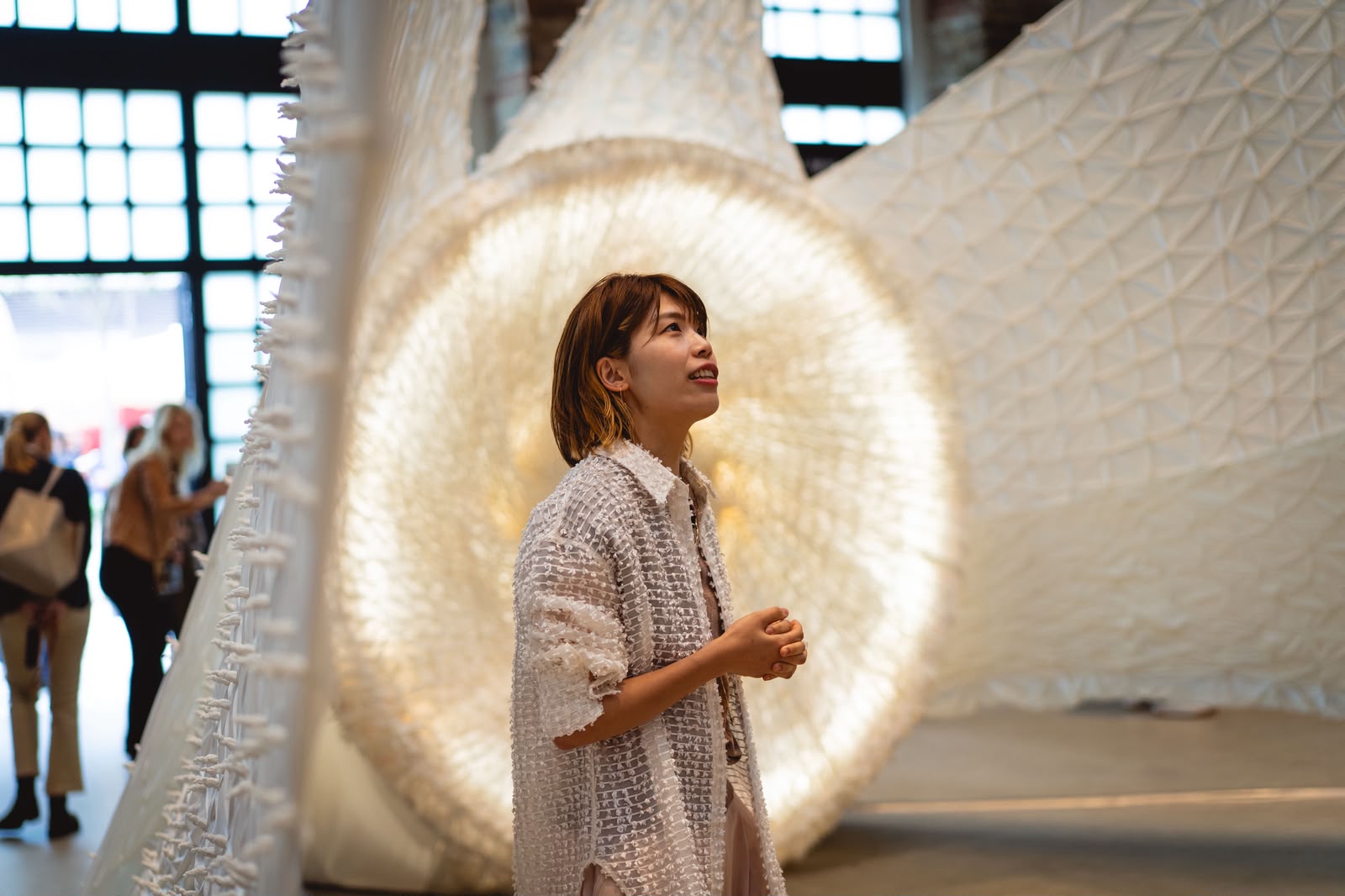
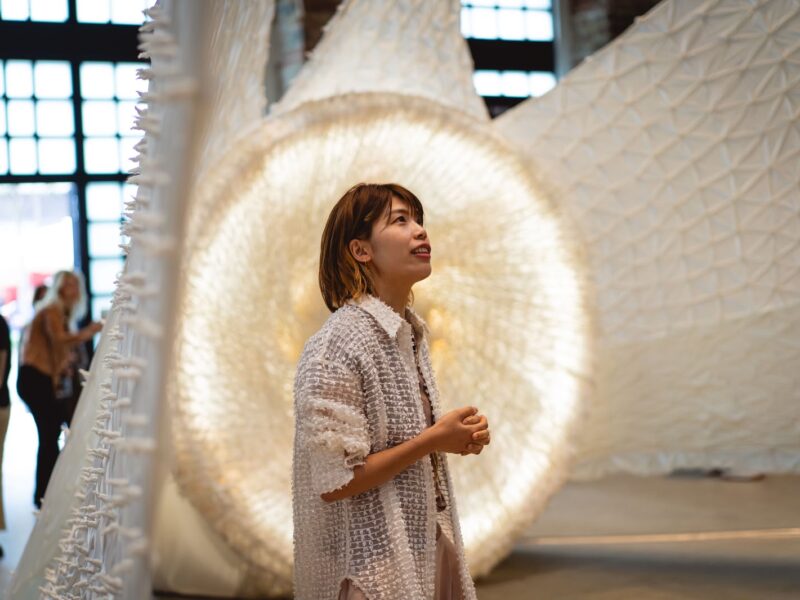
Following the presentation of her installation Sail of Light at Contemporary Istanbul 2026, Japanese artist Chisato Matsumoto reflects on her relationship with craft, the role of perspective, and the experiences shaping her practice.
1. Your works often feel as if they are alive, growing, moving, gathering and transforming. If you had to describe the world you create through your art in three words, what would they be?
Immersion, release, and permeation.
2. There is something very poetic about transforming such a traditional Japanese practice into works that feel so contemporary. Do you see yourself as preserving tradition, challenging it, or creating something entirely new from it?
I want to create something new from tradition.
I believe that tradition can cultivate individuality precisely because each practitioner works to deepen and refine a technique through their own hands. To explore one method deeply and pursue it over time is an important way of engaging with tradition.
But this is not necessarily where my own interest lies. I want to engage with tradition more broadly. Rather than seeking to master a technique itself, I am interested in expanding the meanings and interpretations of craft. I hope that, by intersecting with other fields, it can take on different meanings and become something new.
3. From a distance, your installations can appear almost cosmic, while up close they reveal hundreds of individual details. Do you enjoy the idea that a viewer can discover a completely different work simply by changing their perspective?
I am very interested in how a change in perspective can transform one’s experience of the work.
We are constantly surrounded by repetition and accumulation. When we become conscious of them, we can make a leap in perception that we would not ordinarily experience. I hope viewers can feel that shift.
4. If we walked into your studio on an ordinary working day, what would we find? Is there a ritual, object, sound, or habit that is always part of your creative process?
I often change my working environment depending on the work I am making, but sewing tools are always present. When I hold a pair of heavy fabric shears, I feel a certain tension that helps me concentrate.
5. Is there a work you have created that feels particularly personal to you, perhaps one that changed something in the way you see yourself as an artist?
There is a work titled Beyond the Stars.
During its installation, many people helped me bring the work into the space. Through that experience, I realised that a work can no longer be complete through me alone. I remember this as an important change in the way I see my practice.
6. White has such a strong presence throughout your work. What draws you to it, and what does white allow you to express that other colors perhaps cannot?
The forms in my work are often quite elemental, which makes colour especially important.
Among colours, I think white is especially open to the imagination of the viewer. Each person can bring their own sensibility and imagination to it. I am drawn to that space of possibility.
7. You are presenting Sail of Light in Istanbul, a city where different histories and cultures constantly overlap. What has stayed with you most from bringing your work to Istanbul?
With Sail of Light, I initially imagined people gathering from the outside towards the light, concentrating at its centre.
Many visitors in Istanbul seemed to receive this image naturally. At the same time, several visitors from elsewhere said that the work appeared to expand outwards from the centre. Even when looking at the same work, the direction of its movement can be perceived differently depending on one’s cultural background and experience.
Encountering these different interpretations was the moment when I most strongly felt that I had truly brought the work to Istanbul. It reminded me that the work does not have one fixed direction or meaning.
8. And finally, what are you curious about right now not only as an artist, but as a person? Is there something you are currently seeing, reading, experiencing, or thinking about that might quietly find its way into your future work?
Recently, my nephew was born.
Watching this small life grow, I have been thinking about its warmth and its weight. I do not know whether these feelings will find their way into my work, but they are new to me, and for now I am trying to hold on to them carefully.